
Prague rose while the surrender of Germany was still being negotiated. On May 5, 1945, Czech resistance groups and civilians challenged the occupation authorities, seized positions and built barricades. The struggle around the radio building gave the uprising a voice that could reach beyond the city. Its appeals were urgent because Prague remained within a substantial German military position. News of Hitler’s death and Berlin’s surrender had made liberation seem close; neither event had removed the German forces capable of attacking the barricades.779
The resistance had both a political and a military task. The Czech National Council claimed authority as the occupation collapsed, while commanders had to organize a battle with limited arms against forces possessing heavier weapons. Holding a street required men, ammunition and some protection against armour. Holding a city also required communication between districts and a decision about what to do when German commanders offered terms. To the Germans, Prague’s roads and bridges were potential routes west. To the insurgents, control of those same routes could prevent the occupation from ending in another destructive battle fought through their homes.
Help arrived from a politically unexpected direction. Troops from Major General Sergei Bunyachenko’s First Division of the forces associated with Andrei Vlasov fought the Germans in Prague. These men had served in a formation created under German sponsorship from Soviet opponents of Stalin and former Soviet prisoners of war. Their intervention on May 6–7 was consequential, but it should not be described as the whole of “Vlasov’s army” liberating the city. The Russian historian Kirill Alexandrov’s account distinguishes Bunyachenko’s division from that broader label and places its withdrawal during the night leading into May 8.780
The alliance was temporary and precarious. Assistance against German troops did not erase the division’s service alongside Germany or its exposure to Soviet punishment. The Czech National Council could not make that problem disappear by welcoming the help. Nor could the division obtain a secure future simply by turning its weapons against its former patrons. Accounts collected by Memory of Nations describe both its participation and the resistance leadership’s distancing itself as the prospect of Soviet arrival became decisive. The division’s men moved west hoping for protection that the insurgent leadership could not guarantee. Prague’s struggle contained choices for which no available military partner offered a safe political answer.781
Reims and Berlin
At Allied headquarters in Reims, the German delegation was trying to preserve a different kind of interval. Admiral Hans-Georg von Friedeburg arrived on May 5 to explore surrender arrangements. Dönitz still hoped to move German forces westward and avoid handing them over to the Soviet armies. Eisenhower refused a settlement that would end resistance against the Western Allies while permitting it to continue in the east. The negotiations concerned all German forces. The coalition’s demand deprived the remaining German leadership of the political opening it had repeatedly sought.783
General Alfred Jodl, chief of the Wehrmacht operations staff, came to Reims on May 6. Further delay brought a direct threat from Eisenhower: negotiations could be broken off and the western front closed to additional German movement. Faced with losing the possibility of bringing men into Western captivity, Jodl requested authority to accept a complete surrender. Dönitz granted it. The pressure was effective because it attacked the purpose for which the Germans had been bargaining. Continuing to talk would no longer necessarily buy them more opportunities to move troops west; it could close those opportunities altogether.784
Jodl signed at Reims in the early hours of May 7. The document records 2:41 a.m. Walter Bedell Smith signed for the Supreme Commander of the Allied Expeditionary Force, Ivan Susloparov for the Soviet High Command, and the French general François Sevez witnessed the act. It surrendered German forces on land, at sea and in the air to both commands simultaneously. This was a binding general military surrender, not a surrender to the Western Allies alone. Its geographic reach was fundamental: a German army could not claim that the document left it free to continue fighting the Soviets.785
The agreement also created a distinction between signing and effectiveness. It ordered active operations to cease at 11:01 p.m., Central European Time, on May 8. The interval allowed orders to be transmitted through a broken military system, but German commanders were also intent on using the remaining time for movement. The practical conflict did not disappear with Jodl’s signature. To the Allies, the surrender required forces to stop in place at the prescribed time and obey further orders. To men trying to reach a Western line before that deadline, every remaining hour still appeared valuable.786
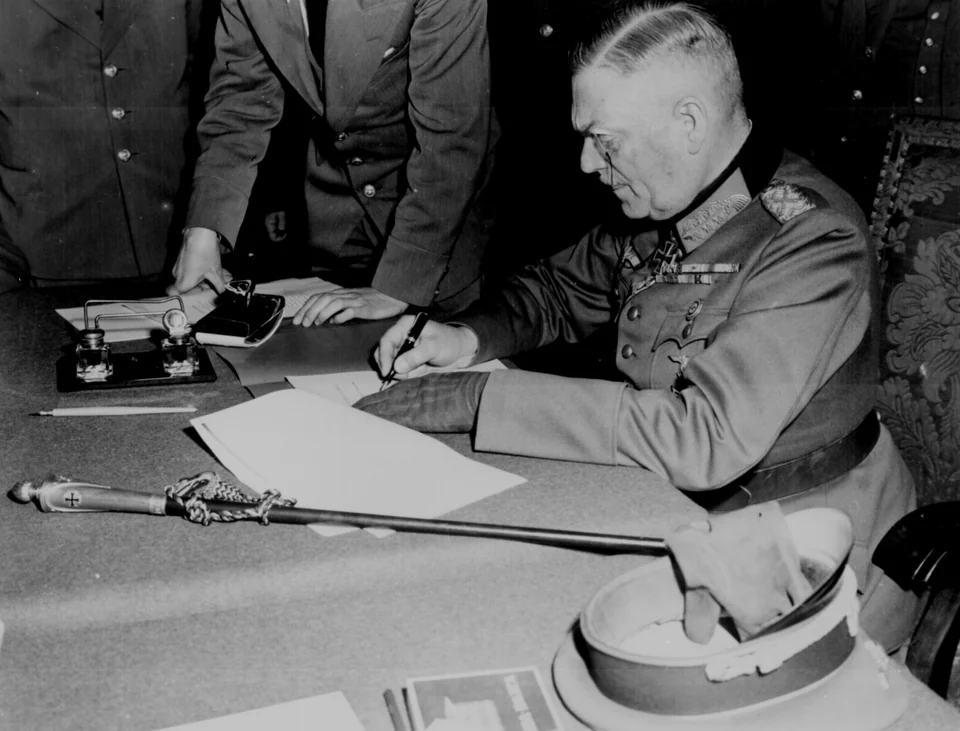
A further signing took place at Berlin-Karlshorst during the night of May 8–9. The German representatives were now Field Marshal Wilhelm Keitel, Admiral von Friedeburg and Colonel General Hans-Jürgen Stumpff, representing the armed forces and their principal services. Marshal Zhukov and Air Chief Marshal Arthur Tedder signed for the Soviet and Western Allied commands; Carl Spaatz and Jean de Lattre de Tassigny signed as witnesses. The document bore the date May 8. Preparation and transmission of the language versions contributed to a ceremony that extended beyond midnight. The dated act and the time people actually put their pens to paper should therefore be kept separate.787
The Berlin text retained the same ceasefire deadline and made the requirement to disarm completely and hand over weapons and equipment explicit. It also prohibited destruction of the means of war. Those provisions addressed the conduct of formations in the field, rather than merely the dignity of the ceremony. A signature was supposed to stop guns firing, prevent equipment from being destroyed and place armed men under the authority of the victors. The surrender remained military in scope, leaving broader arrangements for Germany to the Allied powers.788
The road to Prague
Meanwhile, Soviet operations had continued. Konev had planned the movement against Army Group Centre before the Prague uprising began; news of the uprising added urgency and helped bring the opening forward from May 7 to May 6. The First Ukrainian Front attacked from the north and northwest, while the Second and Fourth Ukrainian Fronts pressed towards the remaining German position from the southeast and east. The operation combined the defeat of a substantial field force with the need to reach an occupied capital whose inhabitants were already fighting. It was neither improvised entirely in response to the radio appeals nor detached from their urgency.789
The northern thrust placed particular demands on Konev’s mobile formations. Tanks that had recently fought around Berlin had to reach new assembly areas and then traverse the approaches through the Erzgebirge, the Krušné hory. Forward detachments combined armour with infantry and engineers so that an obstructed route could be reconnoitred, opened or bypassed. Rain and difficult roads limited the freedom of the tanks, while German resistance required the supporting armies to keep moving with them. Konev’s account describes the opening as a combat operation whose pace had to be earned, despite Germany’s unmistakable strategic defeat.790
The Western armies had reached a different stopping point. American troops entered Plzeň, or Pilsen, on May 6. General George Patton wanted to continue towards Prague, but Eisenhower had agreed to a demarcation arrangement after exchanges with the Soviet command. General Alexei Antonov had objected to a deeper American advance on the grounds of avoiding confusion between the forces. Eisenhower accepted the limit. The immediate decision came from these operational exchanges during the final campaign, not from a Yalta agreement assigning the liberation of Prague to one army.791
For people listening in Prague, the distinction between a nearby Allied army and an army ordered to enter the city was painfully important. American arrival in western Bohemia could be reported accurately and still nourish a false expectation of immediate rescue farther east. Radio appeals, rumours and sightings travelled without carrying the full content of decisions made at higher headquarters. The insurgents had to continue fighting and negotiating with the forces actually around them. Knowledge that Germany had surrendered did not by itself remove the German weapons commanding their streets.
On May 8, the Czech resistance leadership and General Rudolf Toussaint reached an agreement permitting German troops to leave Prague westward. Much of the garrison withdrew. Some SS elements continued fighting, so the agreement did not clear every district or eliminate every threat before the Soviet arrival. The city’s liberation consequently involved the uprising, the negotiated withdrawal and the final entry of Soviet forces. No single one of those events adequately substitutes for the others.792
Soviet tanks reached Prague early on May 9. Konev identifies the Tenth Guards Tank Corps of Dmitry Lelyushenko’s Fourth Guards Tank Army and the Ninth Mechanized Corps of Pavel Rybalko’s Third Guards Tank Army among the first formations to enter. Crowds greeted the arriving soldiers, while fighting continued against German groups in parts of the city. The experience could change from one street to another: celebration in a place where resistance had ended, combat where it had not. Konev’s own narrative preserves that contrast even as it gives the Soviet arrival the central place in the liberation.793
There was a final irony in the reporting of the success. Konev received preliminary word that his tanks were in Prague, then struggled to obtain a sufficiently detailed account from his forward commanders. Communications had been interrupted, and officers sent to discover what was happening were slow to return. His memoir attributes some of the delay to the crowds embracing the arrivals and keeping them in the streets. The recollection is affectionate, but the command problem was real within his account. Moscow wanted confirmation for a victory announcement. Konev wanted to know where resistance remained and in which direction German forces were moving. A message that Prague was theirs answered only part of those questions.794
This was a much happier form of uncertainty than the insurgents had endured, but it belonged to the same uneven circulation of information. The person celebrating beside a tank could know that liberation had reached that street before a headquarters far away possessed a reliable report. Conversely, a headquarters could know that Germany had accepted general surrender while an isolated group continued to fight. The last campaign repeatedly produced these mismatches between what had happened, what had been reported and what people were able to do about it. The signatures did not eliminate them. They established the obligation around which the remaining confusion had to be resolved.
The operation extended beyond the city. Converging Soviet formations cut into the routes available to Army Group Centre, collected prisoners and dealt with groups that still resisted or attempted to move west. Konev records further trouble around Mělník on May 9, after victory celebrations had begun. In the following days, the practical completion of surrender required troops to find, disarm and assemble men spread across a wide area. The liberation of Prague supplied another recognizable date; the end of the surrounding military operation remained a matter of roads, encounters and orders reaching their destinations.795
Two dates for victory
May 8 and May 9 commemorate the same German defeat through different announcement and timekeeping traditions. The Western Allies celebrated Victory in Europe on May 8. Moscow announced and celebrated victory on May 9. The surrender instrument’s fixed deadline, expressed in Central European Time, already fell on May 9 by Moscow time. The Karlshorst ceremony also crossed midnight locally while its document retained the date May 8. It is therefore unsafe to use a document’s date, the hour of signing, the ceasefire deadline and the day of public celebration as if they were interchangeable.796
The distinction is more than a matter of clocks. To a family in London or Moscow, the official announcement could make an already expected victory suddenly public and shared. To a soldier outside Prague, it might arrive while his unit was still engaged. To a camp prisoner, it might precede the first liberating troops. The calendar gives the historian an indispensable framework, but experience followed the arrival of information and the removal of danger. That is why the dates must be precise without being asked to represent an identical ending everywhere.
Nor should the second ceremony be used to divide the coalition’s victory into two unrelated surrenders. Soviet and Western representatives participated in the general surrender arrangements, and the military obligation applied to German forces facing both. The renewed act at Berlin gave the capitulation greater seniority and ceremony in the conquered capital. It did not leave Reims as an agreement under which Germany could legally continue its eastern war. The documents together removed the basis for the remaining German leadership’s central manoeuvre: surrendering selectively while using continued resistance elsewhere to gain time.797
By May 11, the great organized contest on the Eastern Front had ended in German defeat. There were still armed men to collect, casualties to treat and people moving through the wreckage of the last operations. Those tasks belonged to the immediate aftermath of victory, although they could remain dangerous. The soldiers who had reached Berlin and Prague had accomplished the military purpose for which they had fought. The people they found—prisoners, forced labourers, the displaced and the inhabitants of defeated cities—now faced the harder-to-date question of what survival would permit them to recover.