
Budapest did not become a pocket because a single Soviet attack carried straight through its outskirts. The city was approached, threatened and approached again, while the battle spread across the plain east of the Danube and then crossed to the river’s western side. Each unsuccessful attempt changed the conditions of the next. German and Hungarian forces could block one road, but doing so often required men taken from another. By December, the defence of the capital depended increasingly on battles fought beyond sight of its buildings. The streets could still appear to belong to ordinary urban life while the routes that sustained them were being cut.
The starting point was the exhaustion left by the October fighting around Debrecen. The Soviet Second Ukrainian Front had advanced into Hungary but failed to destroy all the German forces it had hoped to trap. Rodion Malinovsky’s mobile formations needed replenishment and repair. The Germans had preserved troops through counterattack and withdrawal, without restoring their earlier strategic position. The outcome gave neither side a clean beginning. Soviet superiority remained formidable; converting it into a rapid capture of Budapest still required an operation that could bring infantry, armour and supplies together.291
Stalin wanted speed. The October 28 directive sent Malinovsky towards the Hungarian capital, and the attack began on October 29. In the account examined by Krisztián Ungváry, Malinovsky sought more time to assemble his forces but was required to proceed. The immediate route ran through the country between the Tisza and Danube, with the Forty-sixth Army carrying the principal southern approach. This was an attempt to exploit the unsettled Hungarian front before the defenders could organize an effective barrier around the city. A prompt entry promised both a military success and the overthrow of the capital’s remaining role in Germany’s war.292
The advance initially seemed to vindicate the urgency. Kecskemét fell on October 31, and Soviet spearheads approached Budapest from the southeast during the first days of November. The capital was close, but the spearheads needed the forces following them. A force emerging from a successful advance might arrive with its fuel, ammunition and supporting infantry unevenly distributed. The defender’s shorter movement along local roads could concentrate resistance just as the attacker had to bring additional resources forward. Nearness to the objective did not mean readiness to take it.293
German reinforcements helped stabilize the approaches. The initial Soviet thrust was checked, and by November 6 the Forty-sixth Army had pulled back from its most advanced positions. Ammunition shortages and concern for its flank contributed to the decision. Budapest had received a reprieve, but the failure of this direct attempt did not remove the threat. It encouraged a change in the shape of the offensive. Instead of treating the capital as an objective to be entered from the southeast, the Soviet command increasingly treated it as a position whose northern and western communications could be reached from outside.
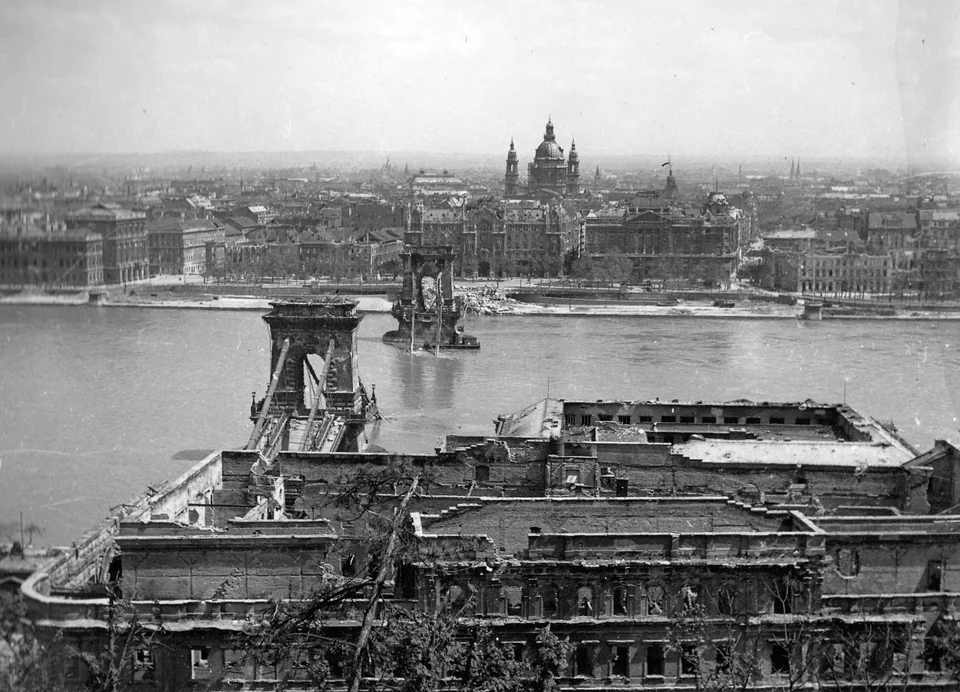
The pause was deceptive for inhabitants. A halted army could be mistaken for an army that would not return, especially when shops, transport and workplaces continued to function. On November 4 an explosion destroyed several spans of the Margaret Bridge. The bridge was both a piece of the city’s daily movement and a military structure prepared for demolition. Its loss gave a material form to a fear already justified by German withdrawals elsewhere: infrastructure could be destroyed before residents had finished using it. The city’s passage from threatened capital to battlefield had begun even while the main fighting remained outside.294
Around the capital, across the Danube
The wider approach placed new demands on Malinovsky’s armies. Beginning on November 11, Soviet attacks pressed northwest from the Tisza towards the country around Hatvan and Miskolc. Hatvan mattered because the ground nearby offered a route towards the Danube bend north of Budapest. Miskolc controlled communications farther northeast and supported important industry. The attacks did not all point at the capital itself. By threatening the routes behind and beside it, they obliged Army Group South to defend a larger problem with the same diminishing resources.295
The terrain shaped those choices. The broad plain encouraged an expectation of mobile warfare, but rivers, hills and constrained corridors repeatedly interrupted it. A tank army could not simply spread evenly across every kilometre of an advance. It needed routes able to carry fuel and ammunition as well as tanks. Infantry had to clear or contain positions that could interfere with those routes. German counterattacks were especially troublesome when Soviet spearheads had moved ahead of the troops needed to secure their sides. The lessons of Debrecen remained close enough to influence the willingness to take another apparent shortcut.
Romanian forces were part of this campaign, not spectators appearing after its result had been decided. Romania’s change of sides had brought its armies into operations under Soviet direction against Germany and Hungary. Romanian infantry formations fought within the Second Ukrainian Front’s wider offensive, though their assignments and condition differed. Romanian units participating in the struggle for the capital and its approaches should not be confused with every Romanian formation fighting farther north. Their presence also made the campaign a striking reversal of the coalition that had carried the Axis war eastward. Former allies were now firing across a front reorganized by the defeats of the summer.296
The Romanian armistice had made participation against Germany and Hungary an obligation under Allied, in practice Soviet, direction. Fighting westward therefore served national efforts to escape the consequences of the earlier alliance while taking place within a command relationship Romania could not freely determine. A Romanian soldier’s contribution and his government’s diplomatic position were connected without being equivalent. The attack required his unit’s infantry, artillery and endurance; decisions about how that contribution would be recognized belonged to a much less equal political relationship. The Soviet front’s success should retain the identity of the Romanian formations that helped produce it.297
Malinovsky’s advance alone did not complete the encirclement. Farther south, Fyodor Tolbukhin’s Third Ukrainian Front moved into a position from which it could intervene west of the Danube. Its preceding operations in the Balkans had placed its armies along a different approach to Hungary. Each front managed its own movements and supply, making coordination essential. One had to secure the crossings and ground from which the western arm could reach north, while the other sustained pressure east and north of the capital.
Small bridgeheads at Apatin and Batina in November opened that possibility. Bridging equipment and follow-up formations turned footholds on the far bank into bases for a larger movement. On November 22 the Fourth Guards and Fifty-seventh Armies broke out. Mohács fell on November 26, and Pécs on November 29. The Fifty-seventh Army moved towards the country south of Lake Balaton; the Fourth Guards Army drove northwest and then north. Tolbukhin was creating a Soviet front west of the river, where the defenders of Budapest could no longer rely on the Danube as a secure western boundary.298
The German response was complicated by the relationship between Hungary and the retreat from the Balkans. Troops that existed on a return could not necessarily be delivered where Army Group South needed them. Damaged crossings, partisan attacks and demands along the withdrawal routes delayed or retained formations farther south. A reserve was useful only when it could arrive with enough strength and equipment to fight. The difference between prospective reinforcements and troops actually present became one of the recurring frustrations of the German defence. It also gave the Soviet armies an opportunity to widen their gains before a coherent line could be restored.
In early December the threat closed around Budapest from both sides. The Forty-sixth Army forced the Danube near Ercsi, south of the capital, and subsequently operated under Tolbukhin’s command. To the north, Malinovsky’s Seventh Guards and Sixth Guards Tank Armies advanced towards Vác and the Danube bend. The western approaches now mattered as much as the eastern perimeter. Holding the fortified ground before Pest could not protect the roads behind Buda if Soviet forces reached them from the south and northwest. The defenders' problem had become one of preserving a connection through a narrowing area.
Weather denied either side an effortless solution. Rain and temperatures insufficient to freeze the ground made the country around Lakes Balaton and Velence difficult for armour. German plans for a counterattack depended partly on ground conditions improving. Meanwhile Soviet infantry could sometimes work through ground that channelled tanks onto roads. That did not make infantry immune to supply problems or casualties, but it meant that a German armoured concentration could fail to control the whole space in which the enemy was moving. The relationship between machines and the terrain mattered more than the number of machines alone.299
Who could order the city to be abandoned?
The military argument for avoiding an encirclement was plain. Withdrawal before the roads closed could preserve troops, shorten the front and keep mobile formations available. It would also surrender a capital, abandon fixed stores and expose the next defensive positions. These were substantial consequences, but they were consequences commanders could compare while movement remained possible. Once withdrawal required breaking through an encircling army, its cost and uncertainty would rise sharply. The central command repeatedly postponed the decision until an ordinary retreat had become a much more dangerous operation.
Hitler’s reasons for holding Budapest combined military, economic and political considerations. Western Hungary helped shield the approaches to Austria. Oil and other resources in the region remained important to a German war effort increasingly starved of fuel. The retention of the Hungarian capital also carried prestige at a time when Germany was trying to recover the initiative in the Ardennes. Yet an argument for defending Hungary did not automatically establish an argument for trapping a large garrison inside Budapest. The city and the region were connected strategic objects, not identical ones.300
The order for a house-to-house defence was explicit by November 26. Military preparation within the city followed, but the existence of barricades and firing positions could not answer the question of whether the city ought to be encircled. Fortification made continued resistance possible; it did not make the decision to resist indefinitely sound. A fortress could tie down enemy formations, but it also immobilized its own garrison and imposed a supply requirement that the forces outside might be unable to meet. Those costs must be counted alongside any later claim that holding Budapest delayed Soviet operations elsewhere.
German command arrangements placed Karl Pfeffer-Wildenbruch’s Ninth SS Mountain Corps over the garrison. Hungarian troops remained a substantial part of the defence, with their own commanders and institutions, including Iván Hindy’s First Corps. Their presence did not give Hungary an independent veto over Hitler’s orders. Ferenc Szálasi’s Arrow Cross regime remained committed to the German alliance after the failed October attempt to leave the war. Its political survival and the German military position were now bound together, while the residents of Budapest had little influence over the decision to make their city a fortress.301
The troops themselves were not a uniform body. German army formations, Waffen-SS units, Hungarian divisions and smaller detachments differed in training, equipment and willingness to continue. Ethnic German conscripts from the region served in SS formations whose designation should not be mistaken for a guarantee of elite combat quality. Hungarian soldiers could be defending their home city, obeying orders, fearing captivity or seeking a way out. Recognizing those differences explains conduct more accurately than assigning a single motive to the garrison. It does not change the character of the German and Arrow Cross cause that the defence sustained.302
Nor can the German dispute be reduced to sensible generals opposed by Hitler alone. Heinz Guderian resisted withdrawals and pressed the army group to use its armour aggressively. Friessner and Maximilian Fretter-Pico, commanding Army Group South and the Sixth Army, were removed on December 22. Their replacements, Otto Wöhler and Hermann Balck, inherited the same terrain and shortage of time. Wöhler quickly asked to free a division from the Budapest position. Changing the commanders had not removed the danger that had led their predecessors to make similar requests.303
Civilian evacuation had not been organized on a scale matching the approaching disaster. Many residents did not wish to abandon homes and possessions; refugees already crowded the shrinking territory still under German control. Moving civilians west would create demands for transport, accommodation and food which the authorities were unwilling or unable to meet. The result was not a city prepared to shelter its inhabitants through a siege. It was a capital whose population remained largely in place while military preparations assumed that resistance would continue around and among them.304
The roads disappear
The renewed Soviet attacks of December 20 made the remaining choices urgent. Tolbukhin’s forces pressed north from the Lake Velence sector, while Malinovsky attacked from the north. German armour attempted to restore the situation, but tanks without adequate infantry support could not seal every penetration. Soviet troops moved around positions and threatened the places from which the tanks themselves had to obtain fuel. A counterattack could succeed locally while the routes behind it deteriorated. The army group was being forced to react across a widening set of emergencies without resolving the central one: the city was losing its road out.
Bicske fell on December 23, cutting the principal western road and railway connection. The remaining route through the hills towards Esztergom was already threatened. On Christmas Eve Soviet troops reached the western suburbs, and on December 26 the advance to Esztergom completed the encirclement. The chronology is important because the pocket did not materialize only when the last gap closed. Supply and movement had already been disrupted during the preceding days. A division ordered to withdraw late could find that its first task was to fight for the suburb through which it was supposed to pass.305
Inside the closing ring, the journalist Jenő Lévai recorded a Christmas defined by cannon fire and emptied streets. Regina Fritz’s study draws on his wartime diary to recover that moment. His record places the military change within a city still inhabited by people trying to obtain food and shelter. For its persecuted Jews, the disappearance of normal movement did not suspend the threats posed by the Arrow Cross. Encirclement placed a new battlefield around an existing campaign of persecution. The two dangers would increasingly occupy the same streets.306
Buda and Pest now formed two halves of one trapped capital. Pest lay on the flatter eastern bank; Buda rose through hills on the west. The Danube bridges connected troops, services and inhabitants, but the routes leading beyond both halves were held or threatened by the besiegers. A bridge within the pocket could move a wounded man from one bank to the other without moving him any nearer an unbesieged hospital. A railway station could remain inside German lines while the railway beyond it had ceased to function as a supply route. The city’s infrastructure retained its physical forms after losing some of its essential connections.
The garrison also lost access to stores outside the perimeter. That made the location of supplies as important as their existence on an inventory. Food and ammunition intended for the defence were of little use if they lay on the other side of the Soviet ring. Resupply would now depend heavily on air transport, improvised river movement and the possibility of reopening a land corridor. Each method required conditions the defenders could not create by order. The command’s commitment to hold had outlasted its ability to choose how the city would be sustained.307
An immediate breakout was considered and forbidden. The German high command instead moved the Fourth SS Panzer Corps towards Hungary to restore contact from outside. That choice preserved the fortress order and transferred the burden of changing the situation to a relief force. For the trapped soldiers, it offered a reason to keep resisting. For civilians, it extended a period in which food, medical care and freedom of movement would depend on a battle they could neither direct nor escape. Budapest had become an encircled city. What remained undecided was how long the order to hold could be made to survive its material consequences.308