
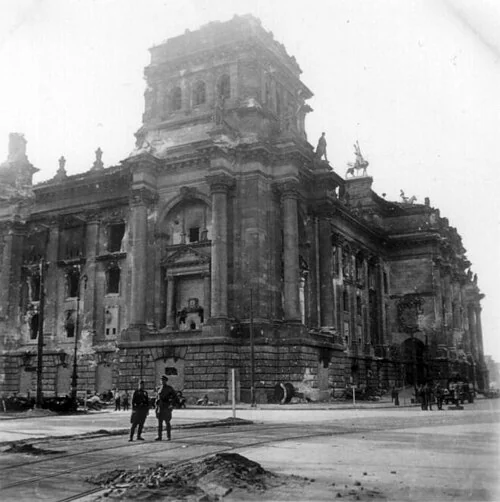

The approach to surrender began with another passage through the lines. During the early hours of May 2, 1945, representatives of Berlin’s defence command sought contact with Soviet troops. Colonel Theodor von Dufving, who had accompanied the previous day’s mission, now carried authority from General Helmuth Weidling. The purpose had changed. There was no attempt to secure recognition for a government in the bunker. The Berlin command wanted to stop the fighting. Even then, Dufving had to explain the difficulty of making an arrangement effective in streets where men might continue to fire because they had received no new instructions.750
Weidling himself crossed to the Soviet side at about six in the morning and was then brought to Chuikov’s headquarters. Zhukov’s account records the report of his surrender slightly later, illustrating the ordinary difference between an event and the receipt of news at a higher headquarters. By then, the conditions Weidling had repeatedly described to Hitler had reached their conclusion. There was no relief force coming into the city, ammunition was failing and communications had broken down. The general could offer the authority of the commander of Berlin’s defence, but the surrender would have to be carried into effect among formations whose cohesion had already been badly damaged.751
Chuikov asked for an order that German soldiers would recognize as binding. Weidling’s text announced Hitler’s suicide, explained the futility of continuing the battle and directed the troops to cease resistance. The wording confronted the personal oath that had sustained obedience to Hitler. Its argument was that the man to whom the oath had been sworn had abandoned those still fighting. That explanation may have offered some soldiers a way to obey a final military command without having to resolve, at once, everything they had believed about loyalty. It also placed responsibility for the hopeless defence above the men now being told to end it.752
The treatment of Weidling’s title is a revealing detail. In Chuikov’s account, the description “former commandant” was challenged because the order needed to come from someone who still possessed authority over the garrison. A general who had merely announced his personal retirement could not necessarily tell scattered units to lay down their arms. The surrender therefore used the surviving German chain of command to dismantle resistance. It preserved enough of Weidling’s office to make his final instruction effective, while removing the purpose for which that office had existed.753
The order had then to leave the room. Copies were sent out; German officers accompanied Soviet personnel; radio broadcasts carried the instruction to positions that could no longer be reached by ordinary staff work. Hans Fritzsche, a senior official in the propaganda apparatus, also offered to address the troops. He could lend a familiar public voice to the call to stop, although he had no independent authority to negotiate Germany’s general surrender. These efforts explain why Berlin’s capitulation was a process extending through the day. The signed words were decisive because people carried, read and acted upon them.754
How the firing stopped
For the Soviet formations, the task changed from breaking resistance to identifying where resistance had ended. Men emerging from buildings had to be disarmed and directed away from the line. Officers needed to distinguish a group coming out to surrender from movement connected with another attempt to escape. The battlefield had been made difficult to read by smoke, rubble and disconnected strongpoints; those difficulties did not vanish because the garrison commander had capitulated. A burst of firing in one street could continue after people in the next had already begun to regard the battle as over.
Zhukov’s memoir treats the afternoon of May 2 as the completion of the defeat of the Berlin garrison. That is the appropriate date for the city’s surrender. It should not be made to promise that every weapon fell silent at the same instant or that every German group attempting to leave the wider Berlin area had already been captured. The preceding night’s breakouts and the pursuit beyond the central districts belonged to the same collapse, but they did not share a single local timetable. An official declaration could accurately mark the end of an organized defence while isolated danger persisted around it.755
The Reich Chancellery provides a particularly instructive example of the difference between symbolic capture and the condition of a building when troops entered it. Soviet accounts later celebrated a dramatic final assault. Beevor’s reconstruction emphasizes that many of the remaining defenders had already left and that the buildings contained wounded people and others unable to escape. The contrast is a reason to resist another perfectly arranged last stand. By the time Soviet troops occupied the physical centre of Hitler’s government, much of the leadership was dead, missing or in flight. What remained was a site to search, secure and investigate, as well as a place over which to raise another flag.756
Victory created new responsibilities before the conquerors had finished understanding what they had taken. Soviet security personnel sought documents, prisoners and evidence about the Nazi leadership. Army officers sought to establish control over districts and clear routes for movement. Medical personnel faced people whose conditions could not wait for the administrative divisions between these tasks to become tidy. The city contained overlapping military, political and human emergencies. The end of organized German resistance removed the greatest obstacle to dealing with them, but it did not supply a ready-made organization for every cellar, hospital and crowd.
Captivity and release
The Soviet army had prepared for large numbers of prisoners before the final surrender. An Eighth Guards Army order of April 30, reproduced by Chuikov, directed the creation of a prisoner collection arrangement outside the city, with guards, food and routes for moving captives. Its stated capacity was a planning requirement, not evidence that this exact number of men had already been captured or adequately accommodated. The order shows that capitulation had a physical dimension: prisoners had to be assembled, searched, fed, guarded and moved. A statement that an army had surrendered was only the beginning of that work.757
For German soldiers, laying down a weapon ended one immediate danger while opening an uncertain future. The line between a prisoner column and the civilian population was also less clear than a military return might suggest. Uniformed police, firemen, railway workers and other men could be swept into collection procedures. Beevor describes both wounded soldiers awaiting help and broad round-ups in the defeated city. Such evidence cautions against treating every person counted in a victory total as a fit combatant captured in an organized fighting unit. Prisoner figures and battlefield strength answered different questions, even when celebratory accounts placed them side by side.758
The transition was equally complicated inside hospitals. Weapons had to be removed, wounded men identified and medical care continued amid shortages and damaged services. The guarantees offered in the surrender discussions mattered because they established what Soviet commanders said should happen to those who gave themselves up. They were not a complete record of what happened at every collection point. A humane order and a prisoner’s fear could coexist; so could medical assistance and rough or arbitrary treatment. The historian has to keep the declared policy visible without allowing it to replace the experience of the people subjected to its implementation.759
The surrender discussions also concerned what should be preserved. The Soviet terms forbade damage to facilities serving the population. That provision joined surrender to the survival of the city: a retreating unit could leave a pump or power installation usable, or destroy something that thousands of people would need after the troops had gone. Preventing further destruction was an immediate military responsibility. The damage already done was enormous, but the fact that Berlin was ruined did not make every additional act of destruction inconsequential. A single working installation, a medical store or a route left open could become the basis for helping a district.760
For prisoners being marched away, those concerns could be distant from the next immediate instruction—where to stand, what to surrender, which way to walk. Their status changed more quickly than their understanding of the new authorities. The officer who had commanded them might now be walking in the same column, while the men giving orders wore a uniform they had spent years fighting. Disarmament was therefore a visible change in power experienced through small, direct acts long before anyone could assess the whole machinery of captivity.
For people imprisoned by the Nazi authorities, Soviet arrival could mean release in the most direct sense. Beevor recounts how prisoners in the Gestapo complex were freed as Soviet troops reached them on May 2. That liberation took place amid continuing danger, with men trying to find their way out of a place that had held them in fear of execution. The same collapse that ended the authority of the guards left unfamiliar streets, weapons and exhausted soldiers outside. Escape from a cell did not yet provide directions to a safe home. It did, however, break the power that had made the cell a place from which the prisoner might never return.761
Jewish survivors in Berlin carried a different relationship to the city’s fall from that of Germans who had supported the regime or experienced its defeat principally as national catastrophe. Thousands had survived through concealment or other precarious circumstances, while deportation had destroyed most of the Jewish community that remained within the reach of the Nazi authorities. The people emerging from hiding were therefore coming back into public life in a city whose institutions had helped remove their families and neighbours. Their liberation was real even when there was almost nothing left to which they could return.762
A city under new orders
The army taking possession of Berlin was also becoming its governing power. Berzarin’s first commandant’s order, dated April 28, had already asserted administrative and political authority in Soviet hands. The surviving published excerpt concerning banks required financial operations to stop temporarily, safes to be sealed and reports to be submitted to the military commandants. It also provided for Allied occupation currency to circulate alongside existing money. These were practical assertions of control over a defeated city: authority was reaching from the battlefield into accounts, property and the means by which people might eventually buy necessities.764
At district level, Soviet commandants were to organize the immediate occupation. Chuikov describes the establishment of commandant’s offices as resistance ended. Their work had to begin before a normal municipal life could resume. An order needed somewhere to be received, an official needed someone to answer it, and residents needed to know where authority now resided. The end of the battle created an abrupt transfer of power, but the conversion of that power into water, food, transport and public order required many separate actions. Berlin’s surrender settled who could issue commands. It did not ensure that the city possessed the resources to carry them out.765
Much of the immediate work concerned the essentials that combat had disrupted. Hospitals needed water and supplies; streets needed passable routes; inhabitants needed food they could actually reach. The same army that had used enormous destructive force against the city now had an interest in preventing disease and disorder among its population. Soviet soldiers distributing food could become the first visible agents of that change. Their assistance was significant on its own terms. It could not erase looting or violence by other soldiers, and neither experience should be made to cancel the other in the account of the occupation.
The physical labour of survival also fell on residents themselves. People had to discover which rooms were habitable, whether relatives were alive and where a queue might lead to a meal. A person who had spent days in a cellar could emerge into a street that no longer offered familiar routes or landmarks. The absence of bombardment made these journeys possible, but not necessarily easy. The wounded, the elderly and those caring for children depended on help at a moment when almost everyone nearby had urgent needs of their own. The everyday dimensions of defeat were beginning to replace the immediate demands of sheltering from fire.
For Soviet soldiers, May 2 brought the achievement for which the Berlin operation had been mounted. The German capital had fallen, its garrison had surrendered and the regime’s central buildings were occupied. For Berliners, the same day separated a battle from an occupation whose terms they were only beginning to learn. For Ralph and Rita, it marked the recovery of a future. These experiences belonged together without becoming identical. The city had reached an ending that could be dated and announced. Beyond it, German armies still held territory, commanders still issued orders, and men still died in a war whose general surrender had yet to be obtained.