
Manya Friedman returned from a night shift at Gleiwitz, an Auschwitz subcamp, to find the prisoners preparing to move. The Soviet army was approaching; the Germans were evacuating the prisoners. Her closest friend was in the infirmary and could not look after herself. Leaving her might mean that Soviet soldiers would reach her sooner. It might also mean abandoning her to murder. Rumours that the camp would be burned gave urgency to a decision for which Friedman had no reliable information. With another friend’s help, she took the sick woman out and brought her along. The choice preceded the journey, and the journey would make her responsible for keeping her friend alive.404
For the prisoners, the approaching front did not create a simple movement from captivity to freedom. German authorities could carry captivity with them. As the armies advanced into southern Poland, the SS forced tens of thousands of people westward from the Auschwitz complex. Some would still be under guard when the camps from which they had departed were liberated. Others would be dead beside the roads or in railway wagons. The acceleration of the military campaign narrowed the time available to the perpetrators without immediately depriving them of the power to kill.
The camp is emptied
Auschwitz was a complex of camps rather than a single enclosure. The main camp, Birkenau, Monowitz and numerous subcamps had different functions and different populations. The evacuation therefore followed several routes and timetables. Between January 17 and January 21, the Germans marched approximately 56,000 prisoners out of Auschwitz and its subcamps; further prisoners left by rail. The principal routes converged on Gliwice, known to the Germans as Gleiwitz, and Wodzisław Śląski, called Loslau. There, columns could be transferred to trains carrying them farther into territory still held by Germany.405
The SS sought to remove prisoners and conceal evidence while the military situation was deteriorating around it. Destroying records and installations did not erase the camp’s history, but it complicated the later work of establishing individual fates and the course of particular crimes. Prisoners had already been transferred away before the final January evacuation. The last departures occurred within an institution whose personnel were trying to disperse its surviving labour force and remove traces of its operations. The pursuit of those objectives did not require that every office follow one consistent timetable.406
In theory, the marching columns were to contain prisoners capable of walking long distances. In practice, the distinction between fit and unfit bore little relation to an ordinary assessment of health. Years or months of hunger, disease and forced labour had left many people weak. Some sick prisoners tried to join because they feared what would happen to those left behind. Others had no meaningful opportunity to decide. Children marched with adults. The administrative category of an evacuee concealed a wide range of physical conditions and an immediate uncertainty about which course offered the better chance of survival.407
That uncertainty was justified. Thousands remained in the main camp, Birkenau and the subcamps because they were too ill or exhausted to leave. The departure of the regular guards did not create a secure interval before liberation. SS personnel continued to appear, military units passed through, and murders continued at several sites. The Auschwitz-Birkenau State Museum records approximately 700 Jewish prisoners killed in Birkenau and named subcamps between the final evacuation departures and the arrival of Soviet forces. The different sites and changing populations make it misleading to treat every figure for those left behind as a count taken at the same place and hour.408
The people remaining had to endure the collapse of the institution that had imprisoned them. An SS departure could remove an immediate source of terror while also leaving no organized provision of food, heat or care. Prisoners who could move attempted to help those who could not; others sought ways out. None could be certain that an armed German group would not return. Freedom, in the limited sense of being momentarily unguarded, did not provide the strength to walk beyond the camp or the assurance that the surrounding territory was safe.
For those forced out, the direction was west, towards other camps, not towards release. The same roads that carried retreating troops and equipment also carried prisoners whose presence obstructed and complicated the retreat without protecting them. Guards retained weapons and authority over the columns. A prisoner who fell behind could be shot, and an attempt to escape risked immediate killing. The term death march describes both the lethal conditions and the intentional violence accompanying the movement. Exposure alone does not explain what happened.409
Roads, stations and open wagons
The routes through Upper Silesia turned geographical distance into a succession of physical ordeals. Reaching a station did not necessarily end the march quickly. Trains might be unavailable, routes blocked or destinations changed. Nor did boarding a train guarantee shelter. Prisoners were loaded into unheated freight wagons, including open wagons that left them exposed to the winter air. The railway could carry them beyond the Soviet advance while extending the conditions that were killing them. Its speed belonged to the machinery moving the prisoners; it did not belong to the prisoners themselves.410
Friedman’s group went to the station, found no wagon ready and spent a night in a barn before trying again. When transport came, it consisted of open coal wagons. She placed her sick friend in a corner and used her own body to keep the crowd from crushing her. Her recollection does not describe a journey along a route she understood. It describes repeated movement, delay and changes of direction, with the eventual destination learned only through experience. The friend who had been taken from the infirmary now depended on the small space Friedman could defend around her.411
The testimony also records assistance that guards attempted to prevent. In Czechoslovakia, people brought bread and water to the train. When direct approaches were stopped, some threw bread down from overpasses. Such acts did not amount to control over the transport. They were brief opportunities to reach prisoners still surrounded by armed men. Friedman recalled snow on the blankets being used to relieve thirst. Arrival at Ravensbrück, after a journey she estimated at about ten days, ended this transport without ending her imprisonment.412
Wilek William Loew remembered another open-wagon journey. He had been sent to Auschwitz after earlier resistance activity and arrest. In his testimony, he was uncertain of the station at which he boarded, suggesting that it might have been Gleiwitz. His precise route remains uncertain. He was more definite about his physical condition: frostbite affected both feet, and tight shoes made movement increasingly difficult. A man who had previously believed he could survive began to doubt whether his body would allow it.413
The dangers of interrupted rail movement are documented with particular clarity at Leszczyny/Rzędówka, near Rybnik. A train carrying prisoners from Gliwice halted there during the night of January 21–22. The next afternoon, the prisoners were ordered out. Some were too exhausted to move. SS guards and local German police fired into the wagons, and the survivors were driven westward on foot. More than 300 bodies were subsequently gathered at the station and in its surroundings, including people shot and people who had died from exhaustion or exposure. Transfer between transport methods had become another occasion for killing.415
It would be misleading to turn these accounts into a single standard death march. Routes differed, guards behaved differently, and opportunities for help or escape varied. Some prisoners were moved from subcamps far from the main Auschwitz site; some made long journeys on foot, while others endured a succession of railway transfers. The museum estimates that at least 9,000, and probably about 15,000, Auschwitz prisoners died during the evacuation. This is a reconstruction across dispersed routes, not a precise roll call completed at one destination. The range should be retained rather than hidden behind an apparently exact total.416
The routes also show why the end of Auschwitz as a functioning camp did not mark the end of its prisoners’ suffering. The institution was being dissolved geographically before its victims were freed. A person evacuated in January could be carried into another camp and another forced march. Those later experiences belong to their own chronology. At this stage, the central fact is that German retreat transported a large part of the surviving prisoner population away from the soldiers who were about to reach Auschwitz.
January 27
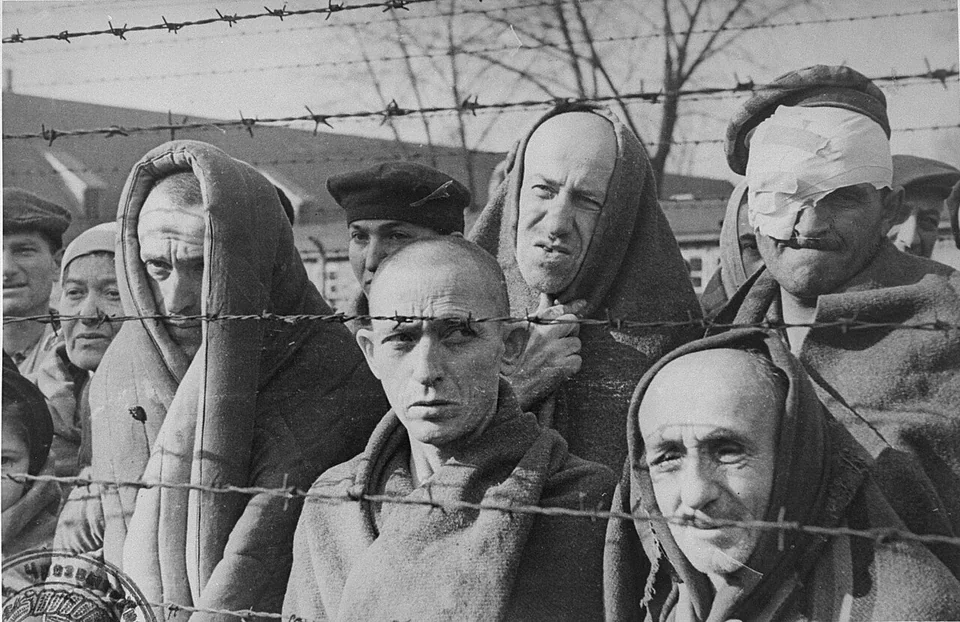
Soldiers of the Soviet 60th Army, part of Konev’s 1st Ukrainian Front, reached and liberated the Auschwitz camps on January 27, 1945. About 7,000 prisoners remained in the main camp, Birkenau and Monowitz. Other survivors were found in the surrounding subcamps before and after that date. The troops encountered people who were ill, starving and often unable to leave their bunks, as well as the bodies of prisoners who had died or been murdered before their arrival. The word liberation describes a concrete change in their circumstances: the SS no longer held them captive, and forces capable of protecting and assisting them had arrived.417
The army’s movement towards the camps formed part of the offensive through southern Poland and Upper Silesia. It should not be rewritten as an operation planned exclusively around Auschwitz. Nor should that operational context diminish what the soldiers’ arrival meant to those they found. A military formation can fulfil an objective within a larger campaign and, in doing so, release people from an immediate threat of death. The two descriptions concern different levels of the same event. For prisoners who had remained alive until that day, the first contact could matter before the identity of the army or the course of its campaign was fully understood.
The title 1st Ukrainian Front did not mean that all its soldiers were Ukrainian. Soviet front names were operational designations, and the armed forces contained people of different nationalities. The liberation should therefore be attributed to the formations involved without turning a command title into an ethnic claim. Likewise, recognizing the liberators does not require accepting Stalin’s political system. Men fighting in the Red Army brought an end to SS power at Auschwitz. The future of Poland and the character of Soviet rule remained separate questions.
Konev later recalled receiving reports about the camp while directing the fighting in Silesia. He wrote that he did not visit immediately, although he was nearby, because the demands of command continued. The recollection places Auschwitz within the uneven flow of knowledge during the offensive. Soldiers on the ground encountered the prisoners; reports moved upwards; a front commander absorbed them while making decisions about other armies. There was no single moment at which everyone involved possessed the same understanding of what had been found.418
The images through which later generations encountered the liberation require similar care. Soviet cameramen recorded survivors, medical examinations, buildings and material evidence in the weeks after the army arrived. They did not film the first encounter as it happened. The Auschwitz Museum’s film archivist, Edyta Chowaniec, distinguishes this record from reconstructed scenes, including a staged release through the gate. Much of the surviving footage documents the aftermath in February and March. A scene of survivors before a camera is evidence of those people and their condition at the time of filming; it is not automatically a view of January 27.419
This distinction strengthens rather than weakens the historical use of the film. The crime does not depend upon every image being an unplanned record of the first day. Survivors’ bodies, abandoned possessions, camp structures and medical findings provided evidence in different forms. Their meaning becomes clearer when the circumstances of recording are identified. Soviet propaganda shaped the presentation, but acknowledging that shaping does not make the prisoners’ suffering imaginary. It allows the record to be read as evidence rather than accepted as a transparent window onto a single event.
Caring for those who remained
The arrival of armed liberators solved the problem of SS control before it solved the problems of starvation, infection and shelter. Soviet medical personnel began organized assistance, and field hospitals took responsibility for patients. Local Polish volunteers also came forward. The work required more than distributing food. People had to be moved from filthy bunks, washed, clothed and placed where treatment was possible. Those who could not stand needed to be carried. Every ordinary act of care encountered the accumulated physical consequences of captivity.420
Józef Bellert’s Polish Red Cross team provides a closer account of that work. Bellert had been involved in medical service during the Warsaw Uprising. In his later report, he described assembling volunteers in Kraków and travelling to Auschwitz on February 5 in a worn truck. They passed columns of Soviet troops moving west and encountered damaged crossings along the way. The people coming to help were themselves poorly clothed and undernourished. Their arrival belonged to the first aftermath of liberation, not to the moment when the camp gates had been reached.421
Their first survey exposed conditions that ordinary hospital routines could scarcely accommodate. At Birkenau, Bellert found patients lying beside the dead and dying, with soiled bedding and no running water or light. The survivors needed a place in which treatment would not mean remaining in the surroundings that had helped destroy their health. Moving them, however, demanded precisely the people, vehicles and equipment the team lacked. A doctor could recognize what ought to be done well before anyone could provide the means to do it. Bellert’s recollection repeatedly moves between these two levels: the needs visible in front of him and the small resources available to answer them.422
Help had already begun beyond the main medical organization. The Polish Red Cross branch at Brzeszcze was caring for twenty-four nursing mothers and their infants before Bellert’s arrival. Local collections and private donations supplied meals. His account records the deaths of two of the children despite this assistance. The episode shows both the reach of local initiative and the limits of what it could repair. A mother released from captivity still needed food and shelter, while her child’s survival depended upon care that captivity had withheld. The helpers could begin providing those things; they could not recover the time already lost.423
There was therefore no clean division between an army’s act of liberation and a civilian institution’s subsequent act of relief. Assistance overlapped, improvised and spread from one group to another. The continued presence of sick prisoners made the camp a place where the consequences of German rule had to be confronted each morning, even as military headquarters recorded new advances hundreds of kilometres away.
Feeding presented its own danger. Severely starved people could not simply resume ordinary meals, however urgent their hunger. The museum records food being introduced in small portions and increased gradually. It also describes bread hidden beneath mattresses weeks after liberation. A supply arrangement could change overnight; the expectation that food might disappear could persist. Care therefore involved both the damaged body and behaviour learned under deprivation. The fact that a patient could now be told there would be another meal did not mean that the assurance could immediately be believed.425
Bellert’s team also needed names. Recording survivors was difficult because people spoke different languages, moved between places, and were not always able to provide clear information. The team initially lacked even a typewriter. Doctors among the former prisoners assisted where they could. Making a list was not merely an administrative task imposed upon people already rescued. It was a means of identifying a patient, tracing a family member and eventually giving someone proof of identity with which to travel.426
The team distributed Red Cross postcards so that survivors could try to contact their families. People arrived at the camp looking for relatives, bringing urgent questions that the medical staff could not always answer. A name absent from one register was not proof that its bearer had died; a name present did not tell a family where the person had subsequently gone. The dispersal of prisoners before liberation had made searching more difficult. The work of identification began amid treatment and burial, before anyone possessed a complete record of the catastrophe.427
Some survivors were strong enough to leave soon; others required prolonged care, and some died after liberation. January 27 could end captivity without reversing the injuries already inflicted. This is the reason to resist making the camp’s final scene a crowd simply walking away. For thousands, the distance between the end of SS rule and the possibility of an independent life remained immense. It had to be crossed through medical attention, food, recovered strength and uncertain news of people who might never return.428
Beyond Auschwitz, the army continued towards the Oder. Behind it, the camp was becoming a hospital, a place of inquiry and a destination for families seeking answers. Farther west, prisoners evacuated from the same complex remained on the move under German guard. The campaign had brought liberation to one place while the machinery of captivity carried others away. Both belonged to January’s history, and neither can be understood by looking only at the line the armies had reached.