
← All Historical Studies

Volume 1 · Chapter 6 · June 21, 1941

Before the Storm

The frontier armies and Germany’s plans for conquest

An invasion assembled in the dark On the evening of June 21, 1941, German formations stood ready to turn months of preparation into an invasion.

Where: The German–Soviet frontier, Finland and RomaniaExplore this date ↗

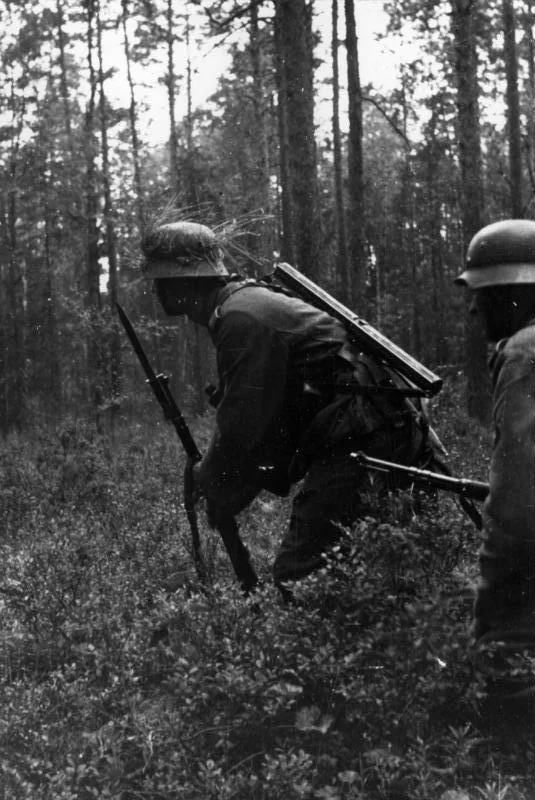
Two helmeted soldiers crouch among trees. The man in front carries a rifle with a fixed bayonet.
German infantry in woodland in a photograph dated June 21, 1941 by the Bundesarchiv. The precise location is unidentified.
Image credit

Heinz Rutkowski / Bundesarchiv, Bild 101I-009-0900-29 · Source · CC BY-SA 3.0 DE · Resized and converted to WebP under the same licence.

An invasion assembled in the dark

On the evening of June 21, 1941, German formations stood ready to turn months of preparation into an invasion. Engineers and supply columns supported an offensive whose first tasks had been assigned; Soviet forces opposite them were still moving from military-district routines towards wartime deployment. Most German formations had reached their final positions in a few night marches. Across the frontier, Soviet commanders still had to bring troops into position and establish the communications needed to direct them.118

Since Poland’s partition, the war had been transformed. France had fallen in June 1940, but Britain continued fighting. German commanders hoped to reproduce the operational successes of 1939 and 1940 across a much greater territory. Their confidence rested partly on methods that had already worked, and partly on a serious underestimate of the Soviet state’s capacity to replace lost armies. Simultaneously, the regime had prepared a war in which military conquest, political destruction, racial persecution and economic exploitation would reinforce one another. Germany was preparing a campaign whose political ambitions were almost unlimited while relying on military arrangements that required a rapid decision.

The frontier deployment concentrated both sides around a few operational problems. North of the Pripet Marshes, the German armies could converge on the Soviet forces projecting west around Białystok, then threaten the crossings leading into the interior. South of the marshes, an advance into Ukraine would encounter a different distribution of Soviet forces and a wider southern flank. The marshes restricted cooperation between those theatres. Destroying the forward armies therefore required several related operations whose results could not be assumed to arrive together. German confidence in a quick decision rested on solving those separate problems before Soviet reserves could establish another front.

For the inhabitants of the borderlands, even the word “frontier” concealed a recent history of violence. The Soviet Union had invaded eastern Poland in 1939 and forcibly annexed the occupied territory; it occupied and annexed Lithuania, Latvia and Estonia in 1940. Military control and Soviet annexation claims did not make the dispossession of these states an uncontested settlement. Millions of people were about to encounter another invading power, carrying its own prescriptions for who could live, who should work and who should disappear.119

From cooperation to a war of conquest

The German–Soviet arrangements of 1939 had made the partition of Poland possible and helped both dictatorships pursue their immediate objectives. They had not reconciled Hitler to the continued existence of the Soviet Union. Germany’s inability to bring Britain to terms sharpened his search for a decisive continental solution. Destroying the Soviet state promised, in his calculation, to remove a potential British partner, secure resources and open the east to German domination. Strategic calculation and ideological purpose reinforced each other. The German planning record places the development of this offensive in 1940, well before the immediate border alarms of June 1941.

The later German claim of a preventive war concealed this sequence. Soviet military thinking included offensive operations, and Soviet deployments were not those of a government indifferent to the possibility of war. Neither fact establishes that Germany’s attack was an emergency response to an imminent Soviet invasion. Hitler’s directive of December 18, 1940, instructed the armed forces to prepare to defeat the Soviet Union while the war against Britain continued. It also required subordinate orders to disguise those preparations as precautions against a possible change in Soviet behaviour. A hypothetical Soviet threat would provide the explanation for preparations already directed towards invasion.

Trade and diplomacy continued alongside operational preparation. Stalin sought to postpone a confrontation while improving the Soviet military position; Hitler could accept economic deliveries while assembling the force intended to destroy the delivering state. The arrangement gave Stalin little control over its ending: avoiding an incident could reduce one pretext for war, but it could not cancel an invasion already chosen for broader reasons.

Soviet expansion in 1939–40 altered this relationship between geography and readiness. The new frontier lay farther west, increasing the distance between an invading army and major interior centres, but the additional territory required garrisons, defensive construction and changes to communications and depots. Strategic depth—the space available to absorb an attack and organize further resistance—became useful only through the ability to employ it. Forward deployment could instead expose formations to enclosure before they withdrew. The Białystok salient was particularly vulnerable because its westward projection lay between German concentration areas, allowing threats to develop along both flanks of the Soviet position.120

Directive 21

The first objective in Directive 21 was the destruction of the main Soviet forces in the western part of the country. German armoured thrusts were to prevent organized armies from retreating into the interior. Territorial advance mattered because it could produce that destruction and deprive surviving forces of bases; it was not supposed to substitute indefinitely for a decisive military result. The directive’s ultimate Volga–Archangel line expressed the intended scale of domination. From that barrier, the Luftwaffe would, if necessary, attack the remaining Soviet industrial region in the Urals. This was a programme for destroying the state’s ability to resist, extending far beyond the frontier battles on which its feasibility depended.

The planning process also contained unresolved questions about priorities after the initial battles. Moscow was the central railway and political objective favoured by much of the army leadership. Hitler attached enormous importance to Leningrad, the Baltic region and the resources of Ukraine. The scheme north of the Pripet Marshes contemplated defeating the Soviet forces in Belarus and facilitating the destruction of those in the Baltic region before completing later advances. The army groups’ operations were meant to support one another, but the priorities after the frontier battles remained disputed.

Directive 21 required preparations needing a long lead time to be completed by May 15, 1941. It left the date of attack to a later decision. Hitler was committing Germany to a quick campaign whose success depended on destroying Soviet military power before the fighting became a prolonged war.121,122

Poland and France had demonstrated the destructive power of penetration and encirclement. They had not demonstrated that the same methods would exhaust the Soviet Union’s ability to raise armies. That required a different judgement, embracing mobilization, industry, transport and political cohesion. German planners moved too readily from confidence in their own operational methods to confidence that the enemy could not recover from them. Racial contempt reinforced the underestimate. The plan rested on a large assumption: the destruction of the armies near the frontier was supposed to settle the much larger question of the Soviet state’s survival.123

Three army groups and four mobile striking forces

Army Group North, commanded by Wilhelm Ritter von Leeb, assembled in East Prussia. Georg von Küchler’s 18th Army and Ernst Busch’s 16th Army supplied the principal infantry formations, while Erich Hoepner’s 4th Panzer Group provided the mobile striking force. Their immediate theatre was Lithuania and Latvia, with crossings of the Western Dvina—Daugava in Latvia—essential to the continuation towards Pskov and Leningrad. The infantry and mobile forces had related but different jobs: a leading formation might secure a bridge while the following armies defeated bypassed resistance, widened the corridor and protected the route over which its supplies would have to pass.

Army Group Centre, under Fedor von Bock, possessed the concentration most capable of producing a deep double envelopment. Hermann Hoth’s 3rd Panzer Group would strike from the northern side of the Białystok salient; Heinz Guderian’s 2nd Panzer Group would operate from the south, across the Bug in the Brest sector. Adolf Strauss’s 9th Army and Günther von Kluge’s 4th Army would attack between and behind them. Minsk lay beyond the salient, on the route towards the Berezina, the upper Dnieper and Smolensk. The two armoured groups gave Bock a capacity that neither neighbouring army group possessed in the same form: he could drive two major mobile arms around a concentration of Soviet forces with infantry following to close and reduce the pockets.

Gerd von Rundstedt’s Army Group South faced a different problem. Ewald von Kleist’s 1st Panzer Group, Walter von Reichenau’s 6th Army and Carl Heinrich von Stülpnagel’s 17th Army would attack into western Ukraine. Farther south, Eugen Ritter von Schobert’s 11th Army and Romanian forces would operate from Romania. Kleist’s striking force had to negotiate rivers, roads and Soviet concentrations while maintaining contact with infantry and protecting an exposed flank towards the Pripet region. The southern wing was initially assigned a more restricted role; a large offensive from the Prut would begin only in July. Its two wings would enter the offensive at different times.

The German air forces were organized to support this operational design. Luftflotten 1, 2 and 4 supported the northern, central and southern sectors respectively, while retaining their own command arrangements. Their opening tasks included attacks on Soviet aviation and communications as well as direct support for the ground advance. Air superiority could isolate formations, disrupt a counterattack and make daylight movement exceptionally dangerous. It could not occupy a railway junction, repair a bridge or deliver all the fuel required by a panzer group. Aircraft and mobile ground forces depended on each other, and both depended on the infantry and supply services.124

The Red Army expands and rearms

Opposite these concentrations stood the western Soviet military districts. On the Baltic approaches, Fyodor Kuznetsov commanded the Baltic Special Military District, which would become the Northwestern Front. Dmitry Pavlov commanded the Western Special Military District, the basis of the Western Front. Mikhail Kirponos’s Kiev Special Military District would become the Southwestern Front. Markian Popov’s Leningrad district covered the northern approaches, while the southern command arrangements were being reorganized around forces in the Odessa district and a new Southern Front headquarters. A Soviet Front was broadly comparable to a German army group.

The Soviet forces were substantial, but their organization was undergoing rapid expansion and repeated reconstruction. Mechanized corps were being created on a scale that outstripped the immediate supply of trained personnel, transport, maintenance facilities and communications equipment. The establishment of a headquarters and the assignment of tanks did not instantly create a force capable of moving, fuelling and fighting together. The frontier districts’ forward formations, known as covering forces, were supposed to protect mobilization and concentration while responding to an attack; in practice, German operations would begin disrupting those very processes before they were completed.

The T-34 and KV illustrate why equipment quality and formation readiness must be examined together. Their armour and armament could give crews a substantial advantage in a particular encounter. Employing that advantage across a battle required trained personnel, suitable ammunition, fuel, recovery vehicles and timely information about friendly and enemy forces. A tank immobilized through mechanical failure or separated from its supporting arms could cease to influence the operation while remaining physically intact. Aggregate inventories combine vehicles in different conditions and locations; they cannot establish how many a commander could bring into action at a specified crossing.

Stalin’s purges also weakened the army. The removal, imprisonment and killing of officers damaged the armed forces and encouraged a climate in which an incorrect judgement could become a political charge. These losses compounded the shortage of experienced officers created by rapid expansion, while new organizations required skills that recent reforms had not yet supplied. These causes interacted. A rapidly promoted commander attempting to master an unfamiliar formation was doing so inside a political system that punished perceived disloyalty and made the reporting of unwelcome information dangerous.125

Warnings without an adequate response

The Soviet government had received warnings of a German attack for months. In March, the United States passed on intelligence it considered authentic; Soviet sources supplied warnings of their own. Stalin’s effort to gain time coexisted with military preparations, but fear of provoking Germany continued to restrict what commanders could do. Postwar Soviet accounts differ over his response. Zhukov recalled Stalin refusing a request for an alert on June 14; Vasilevsky described preparations continuing despite the reassuring TASS communiqué published that day. These accounts leave room for dispute over particular decisions. The outcome was clearer: the forces near the frontier had not reached a common state of readiness before the attack.

Soviet preparations nevertheless varied across services, districts and formations. Movement, reserve call-ups and local precautions indicate that the military apparatus was responding, although its measures did not produce a uniform state of readiness. Dispersal could protect equipment from air attack while making immediate concentration harder; moving a reserve could improve its prospective position while leaving it vulnerable in transit. A formation needed its troops and equipment in position, supplies to sustain them and communications that could survive the opening attack.

The late-night directive associated with June 21–22 captured the tension. It warned of a possible attack, called for combat readiness and measures including the dispersal and concealment of aircraft, but also insisted that forces avoid provocations. Its transmission came too late to give all formations a common period in which to prepare. Commanders had to interpret urgent instructions through communications networks that were about to come under attack. A message received at an army or district headquarters was not simultaneously understood by every regiment, airfield and frontier post.126,127

For commanders near the frontier, the late warning created an immediate dilemma. They had to prepare for an attack while avoiding actions Moscow might interpret as provocation. Preparations also depended on communications, transport and supplies that a warning could not create. The opening assault would force an abrupt change from restraint to counterattack, before many headquarters had established what remained of their formations. The conflicting demands exposed soldiers at the moment when the ability to act together mattered most.

The coalition and the supply problem

Finland and Romania entered German planning for different reasons and under different arrangements. Finland sought to reverse losses imposed after the Winter War and increasingly cooperated militarily with Germany; Romania sought the recovery of Bessarabia and northern Bukovina, taken by the Soviet Union in 1940. Directive 21 anticipated the participation of both, but their forces were not simply additional German divisions. National command structures, territorial objectives and political calculations remained important. German operations from Finnish territory and the presence of German formations in Romania made cooperation materially significant before every public declaration or major ground offensive had occurred.

The northern theatre had its own operational timetable. Operations from northern Finland towards Murmansk and the railway serving it were not identical to Army Group North’s advance from East Prussia. Distance, limited roads and difficult terrain constrained what could be accomplished there. Soviet air attacks on Finland on June 25 were followed by the Finnish government’s public account of a renewed war. By then, military cooperation with Germany was already established. The German–Finnish offensives would unfold on a different timetable from the advance through Lithuania.128

Behind every sector lay the question of supply. German armies depended on railways for the large-scale movement of fuel, ammunition, food and replacements. Moving into the Soviet system required more than changing track gauge: bridges, locomotives, signalling, stations and damaged facilities affected the amount that could actually be delivered. Trucks extended the connection between railheads and fighting formations, but longer journeys consumed more fuel and vehicle life. Seizing a bridge intact was therefore valuable twice over, both for the immediate advance and for the maintenance of forces beyond it.

Much of the German army still moved at the pace of men and horses. The armoured and motorized formations formed a striking minority inside an army whose infantry usually marched and whose transport included enormous numbers of horses. Blau gives approximately 600,000 motor vehicles and 625,000 horses for the initial Barbarossa force; the figures describe the mixed character of the whole undertaking, rather than the equipment available to any particular formation. A mobile spearhead could move far ahead while the men required to secure its flanks and reduce pockets were still approaching on foot. That separation would become one of the campaign’s recurring operational problems.129

The orders behind the front line

Before the invasion, German authorities had also altered the conditions under which soldiers were to treat civilians and prisoners. The decree of May 13 on military jurisdiction in the Barbarossa area empowered officers to shoot civilians suspected of hostile acts outside ordinary judicial proceedings. It also removed the normal obligation to prosecute German personnel for offences against civilians, except where military discipline or security required action. The decree supplied authority for violence before the army encountered the population. Keitel had signed it more than a month before the invasion. At Nuremberg he would defend his conduct by invoking Hitler’s authority, but the decree itself recorded the army’s instructions.

The Commissar Order of June 6 went further by directing the separation and killing of captured Soviet military political commissars, officers responsible for political supervision and education. It expressly denied them the protection normally associated with prisoners of war. The order’s ideological language treated political office as a reason for execution, turning capture into an occasion for selection and murder.130

Food policy made the connection between military supply and civilian destruction equally explicit. Economic directives dated May 23 proposed diverting agricultural surpluses from the Soviet south towards German requirements, cutting the northern forest zone and its industrial cities off from their usual supplies. The planners anticipated mass starvation or flight and rejected feeding the affected population if that competed with Germany’s war needs. Presented at Nuremberg as document EC-126, the directives reveal intended deprivation before the invasion, rather than a famine that authorities had merely failed to foresee. Implementation would vary, but the planners had already subordinated the survival of millions to German supplies.131

Germany had assembled forces capable of inflicting a major defeat at the frontier, while its planning remained dependent on assumptions about what such a defeat would do to the Soviet state. The Soviet leadership had failed to translate warnings and resources into a sufficiently coordinated response before the attack. German preparations served a war of conquest. Soviet errors increased the vulnerability of the army and population facing it. The opening assault would put both systems into action and show whether the destruction of the frontier armies could end Soviet resistance.

Notes and evidence

Evidence notes give detailed references and qualifications. Their source links connect to the references below.

Read 17 evidence notes

Notes prefixed C support additional website context; the manuscript’s note sequence is preserved.

  1. 118. Blau, German Campaign in Russia, 38–41, especially 41; Kipp, “Barbarossa,” PDF 7–8.

    Works and documents: Blau, George E. The German Campaign in Russia: Planning and Operations (1940–1942). DA Pamphlet 20-261a. U.S. Department of the Army, 1955. https://cgsc.contentdm.oclc.org/digital/collection/p4013coll8/id/2460/; Kipp, Jacob W. “Barbarossa, Soviet Covering Forces and the Initial Period of War.” Foreign Military Studies Office. 1989. https://www.glscott.org/uploads/2/1/3/3/21330938/soviet_covering_forces_in_barbarossa.pdf

  2. 119. Blau, German Campaign in Russia, 1, 26–32; USHMM, “Soviet Union and the Eastern Front”; documentary sources in chapters 3–5 (invasion and annexation).

    Works and documents: Blau, George E. The German Campaign in Russia: Planning and Operations (1940–1942). DA Pamphlet 20-261a. U.S. Department of the Army, 1955. https://cgsc.contentdm.oclc.org/digital/collection/p4013coll8/id/2460/; United States Holocaust Memorial Museum. “The Soviet Union and the Eastern Front.” https://encyclopedia.ushmm.org/content/en/article/the-soviet-union-and-the-eastern-front

  3. 120. Blau, German Campaign in Russia, 1, 4–9, 21–25; Hitler, Directive 21, December 18, 1940, in Blau, 22–25, opening and secs. I, IV; Kipp, “Barbarossa,” PDF 3.

    Works and documents: Blau, George E. The German Campaign in Russia: Planning and Operations (1940–1942). DA Pamphlet 20-261a. U.S. Department of the Army, 1955. https://cgsc.contentdm.oclc.org/digital/collection/p4013coll8/id/2460/; Hitler, Adolf. Directive No. 21: Operation Barbarossa, December 18, 1940. German History in Documents and Images, English translation. https://germanhistorydocs.org/en/nazi-germany-1933-1945/ghdi:document-1547; Kipp, Jacob W. “Barbarossa, Soviet Covering Forces and the Initial Period of War.” Foreign Military Studies Office. 1989. https://www.glscott.org/uploads/2/1/3/3/21330938/soviet_covering_forces_in_barbarossa.pdf

  4. 121. Hitler, Directive 21, December 18, 1940, in Blau, German Campaign in Russia, 22–25, opening and secs. I–III; Blau, German Campaign in Russia, 26–32, 34–38.Section IV of Directive 21 required subordinate orders to describe their measures as precautions against a possible change in Soviet conduct. It also restricted the number of officers informed and delayed briefing additional personnel. Officers could be told enough to carry out their duties while the wider purpose remained concealed. Hitler, Directive 21, December 18, 1940, in Blau, German Campaign in Russia, 22–25, sec. IV, 24–25.

    Works and documents: Blau, George E. The German Campaign in Russia: Planning and Operations (1940–1942). DA Pamphlet 20-261a. U.S. Department of the Army, 1955. https://cgsc.contentdm.oclc.org/digital/collection/p4013coll8/id/2460/; Hitler, Adolf. Directive No. 21: Operation Barbarossa, December 18, 1940. German History in Documents and Images, English translation. https://germanhistorydocs.org/en/nazi-germany-1933-1945/ghdi:document-1547

  5. 122. Hitler, Directive 21, December 18, 1940, in Blau, German Campaign in Russia, 22–25, opening; Blau, German Campaign in Russia, 37 (April 30 decision).The May 15 requirement was a preparation deadline. After the Balkan campaign began, the invasion was postponed; on April 30, Hitler selected June 22. The interval between the directive’s preparation date and the eventual attack cannot, by itself, measure the time lost to the Balkans. Nor did Directive 21 set dates for the capture of Minsk, Smolensk or Moscow.

    Works and documents: Blau, George E. The German Campaign in Russia: Planning and Operations (1940–1942). DA Pamphlet 20-261a. U.S. Department of the Army, 1955. https://cgsc.contentdm.oclc.org/digital/collection/p4013coll8/id/2460/; Hitler, Adolf. Directive No. 21: Operation Barbarossa, December 18, 1940. German History in Documents and Images, English translation. https://germanhistorydocs.org/en/nazi-germany-1933-1945/ghdi:document-1547

  6. 123. Wray, Standing Fast, 23, 25–28, 32; USHMM, “Soviet Union and the Eastern Front,” “The Soviet Union in the Nazi Worldview” and “Germany Prepares to Attack.”

    Works and documents: Wray, Timothy A. Standing Fast: German Defensive Doctrine on the Russian Front During World War II, Prewar to March 1943. Research Survey No. 5. Fort Leavenworth, Kansas: U.S. Army Command and General Staff College, Combat Studies Institute, 1986. Printed pagination; official public-release PDF. https://www.armyupress.army.mil/Portals/7/combat-studies-institute/csi-books/wray.pdf; United States Holocaust Memorial Museum. “The Soviet Union and the Eastern Front.” https://encyclopedia.ushmm.org/content/en/article/the-soviet-union-and-the-eastern-front

  7. 124. Blau, German Campaign in Russia, 26–41, especially 34–35 and 38–41; Wichmann, “Carl Heinrich von Stülpnagel,” 1941 entry.

    Works and documents: Blau, George E. The German Campaign in Russia: Planning and Operations (1940–1942). DA Pamphlet 20-261a. U.S. Department of the Army, 1955. https://cgsc.contentdm.oclc.org/digital/collection/p4013coll8/id/2460/; Wichmann, Manfred. “Carl Heinrich von Stülpnagel 1886–1944.” Deutsches Historisches Museum, LeMO. https://www.dhm.de/lemo/biografie/carl-heinrich-von-stuelpnagel

  8. 125. Ziemke and Bauer, Moscow to Stalingrad, 7–13, especially 10–12; Kipp, “Barbarossa,” PDF 3, 8–11.

    Works and documents: Kipp, Jacob W. “Barbarossa, Soviet Covering Forces and the Initial Period of War.” Foreign Military Studies Office. 1989. https://www.glscott.org/uploads/2/1/3/3/21330938/soviet_covering_forces_in_barbarossa.pdf; Ziemke, Earl F., and Magna E. Bauer. Moscow to Stalingrad: Decision in the East. U.S. Army Center of Military History, 1987. Printed pagination; HyperWar transcription and government PDF. https://www.govinfo.gov/app/details/GOVPUB-D114-PURL-gpo82693 https://www.ibiblio.org/hyperwar/USA/USA-EF-Decision/index.html

  9. 126. Ziemke and Bauer, Moscow to Stalingrad, 20–24, especially 22–23 (retrospective accounts, including Zhukov and Vasilevsky); Defence Commissariat, Directive 1, June 21–22, 1941, para. 3(b), translation from Glantz, Barbarossa, app. II.

    Works and documents: Glantz, David M. Barbarossa: Hitler’s Invasion of Russia 1941. Appendix II, NKO directives 1–3. 2001. Reproduced English translations; consulted web transcription has no edition pagination. https://www.geocities.ws/rf_mikael/glantz7.html; Ziemke, Earl F., and Magna E. Bauer. Moscow to Stalingrad: Decision in the East. U.S. Army Center of Military History, 1987. Printed pagination; HyperWar transcription and government PDF. https://www.govinfo.gov/app/details/GOVPUB-D114-PURL-gpo82693 https://www.ibiblio.org/hyperwar/USA/USA-EF-Decision/index.html

  10. 127. Ziemke and Bauer, Moscow to Stalingrad, 7–8, 25, 30.On the eve of invasion, Semyon Timoshenko was defence commissar and Georgy Zhukov chief of the General Staff. Stalin’s political authority was decisive, but the wartime Stavka had not yet been established. It would be created on June 23 with Timoshenko as chairman. Stalin’s formal wartime appointments followed later, although major decisions already required his assent.

    Works and documents: Ziemke, Earl F., and Magna E. Bauer. Moscow to Stalingrad: Decision in the East. U.S. Army Center of Military History, 1987. Printed pagination; HyperWar transcription and government PDF. https://www.govinfo.gov/app/details/GOVPUB-D114-PURL-gpo82693 https://www.ibiblio.org/hyperwar/USA/USA-EF-Decision/index.html

  11. 128. Hitler, Directive 21, in Blau, German Campaign in Russia, 22–25, sec. II; Blau, German Campaign in Russia, 29–31, 36–40; FRUS, 1941, 1, docs. 56–57 (Schoenfeld, telegram 228, June 25, 18:00; Welles, June 26, editorial n. 1). Finnish defensive claims are official explanations.

    Works and documents: The Minister in Finland (Schoenfeld) to the Secretary of State; Memorandum of Conversation, by the Acting Secretary of State; Blau, George E. The German Campaign in Russia: Planning and Operations (1940–1942). DA Pamphlet 20-261a. U.S. Department of the Army, 1955. https://cgsc.contentdm.oclc.org/digital/collection/p4013coll8/id/2460/; Hitler, Adolf. Directive No. 21: Operation Barbarossa, December 18, 1940. German History in Documents and Images, English translation. https://germanhistorydocs.org/en/nazi-germany-1933-1945/ghdi:document-1547

  12. 129. Blau, German Campaign in Russia, 9, 32, 38–41, 47–48; Wray, Standing Fast, 27–28, 38–39. The 600,000 vehicles and 625,000 horses reproduce Blau’s June 20, 1941, table (41); they are not independent corroboration.

    Works and documents: Wray, Timothy A. Standing Fast: German Defensive Doctrine on the Russian Front During World War II, Prewar to March 1943. Research Survey No. 5. Fort Leavenworth, Kansas: U.S. Army Command and General Staff College, Combat Studies Institute, 1986. Printed pagination; official public-release PDF. https://www.armyupress.army.mil/Portals/7/combat-studies-institute/csi-books/wray.pdf; Blau, George E. The German Campaign in Russia: Planning and Operations (1940–1942). DA Pamphlet 20-261a. U.S. Department of the Army, 1955. https://cgsc.contentdm.oclc.org/digital/collection/p4013coll8/id/2460/

  13. 130. Hitler/Keitel, decree of May 13, 1941, C-50, secs. I.1–5, II.1–4, Nazi Conspiracy and Aggression reproduction; IMT, April 5, 1946, 10:612–614; German High Command, “Commissar Order,” June 6, 1941, secs. I.1–2, GHDI translation.

    Works and documents: German High Command. “Guidelines for the Treatment of Political Commissars, 6 June 1941.” German History in Documents and Images. June 6, 1941. https://germanhistorydocs.org/en/nazi-germany-1933-1945/ghdi:document-1548

  14. 131. Economic Staff East, agricultural directives, May 23, 1941, EC-126, USA-316, extracts in IMT, December 17, 1945, 4:4–8.

    Works and documents: Economic Organization East, Agricultural Group. “Economic Policy Directives,” May 23, 1941. Document EC-126. Presented to the International Military Tribunal, December 17, 1945, 4–8. Avalon Project transcription. https://avalon.law.yale.edu/imt/12-17-45.asp

  15. 132. Konstantin M. Simonov, Raznye dni voyny, vol. 1 (1982), chapter 1, opening: https:/​/​militera.​lib.​ru/​db/​simonov_​km/​1_​01.​html.​ Published retrospective account incorporating diary material. Two o’clock is his recollection of receiving the news.

    Works and documents: Simonov, Konstantin Mikhailovich. Raznye dni voyny: Dnevnik pisatelya. Vol. 1, 1941 god. Khudozhestvennaya literatura, 1982. Unpaginated Russian transcription; diary entries and later commentary. https://militera.lib.ru/db/simonov_km/1_08.html

  16. C1. Directive 21, preparation requirement, Blau printed pp. 22–25; April 30 scheduling, pp. 36–38.

    Works and documents: Hitler, Adolf. Directive No. 21: Operation Barbarossa, December 18, 1940. German History in Documents and Images, English translation. https://germanhistorydocs.org/en/nazi-germany-1933-1945/ghdi:document-1547; Blau, George E. The German Campaign in Russia: Planning and Operations (1940–1942). DA Pamphlet 20-261a. U.S. Department of the Army, 1955. https://cgsc.contentdm.oclc.org/digital/collection/p4013coll8/id/2460/

  17. C2. Directive 21, section IV, Blau printed pp. 24–25.

    Works and documents: Hitler, Adolf. Directive No. 21: Operation Barbarossa, December 18, 1940. German History in Documents and Images, English translation. https://germanhistorydocs.org/en/nazi-germany-1933-1945/ghdi:document-1547; Blau, George E. The German Campaign in Russia: Planning and Operations (1940–1942). DA Pamphlet 20-261a. U.S. Department of the Army, 1955. https://cgsc.contentdm.oclc.org/digital/collection/p4013coll8/id/2460/

Links from an earlier revision

This bookmarked passage or reference was revised with the manuscript update. Consult the current text and evidence notes above.

Sources and Further Reading

Imported from the approved Volume 1 manuscript. Native notes preserve exact locators and consultation limits; source migration is not a new historical fact-check.

  1. Blau, George E, Blau, George E. The German Campaign in Russia: Planning and Operations (1940–1942). DA Pamphlet 20-261a. U.S. Department of the Army, 1955. https://cgsc.contentdm.oclc.org/digital/collection/p4013coll8/id/2460/

    Cited in Volume 1. The exact notes retain their locators and access qualifications.

    References in this study: Blau, German Campaign in Russia, 38–41, especially 41; Kipp, “Barbarossa,” PDF 7–8. · Blau, German Campaign in Russia, 1, 26–32; USHMM, “Soviet Union and the Eastern Front”; documentary sources in chapters 3–5 (invasion and annexation). · Blau, German Campaign in Russia, 1, 4–9, 21–25; Hitler, Directive 21, December 18, 1940, in Blau, 22–25, opening and secs. I, IV; Kipp, “Barbarossa,” PDF 3. · Hitler, Directive 21, December 18, 1940, in Blau, German Campaign in Russia, 22–25, opening and secs. I–III; Blau, German Campaign in Russia, 26–32, 34–38.Section IV of Directive 21 required subordinate orders to describe their measures as precautions against a possible change in Soviet conduct. It also restricted the number of officers informed and delayed briefing additional personnel. Officers could be told enough to carry out their duties while the wider purpose remained concealed. Hitler, Directive 21, December 18, 1940, in Blau, German Campaign in Russia, 22–25, sec. IV, 24–25. · Hitler, Directive 21, December 18, 1940, in Blau, German Campaign in Russia, 22–25, opening; Blau, German Campaign in Russia, 37 (April 30 decision).The May 15 requirement was a preparation deadline. After the Balkan campaign began, the invasion was postponed; on April 30, Hitler selected June 22. The interval between the directive’s preparation date and the eventual attack cannot, by itself, measure the time lost to the Balkans. Nor did Directive 21 set dates for the capture of Minsk, Smolensk or Moscow. · Blau, German Campaign in Russia, 26–41, especially 34–35 and 38–41; Wichmann, “Carl Heinrich von Stülpnagel,” 1941 entry. · Hitler, Directive 21, in Blau, German Campaign in Russia, 22–25, sec. II; Blau, German Campaign in Russia, 29–31, 36–40; FRUS, 1941, 1, docs. 56–57 (Schoenfeld, telegram 228, June 25, 18:00; Welles, June 26, editorial n. 1). Finnish defensive claims are official explanations. · Blau, German Campaign in Russia, 9, 32, 38–41, 47–48; Wray, Standing Fast, 27–28, 38–39. The 600,000 vehicles and 625,000 horses reproduce Blau’s June 20, 1941, table (41); they are not independent corroboration.

    ↩ Return to text
  2. Kipp, Jacob W, Kipp, Jacob W. “Barbarossa, Soviet Covering Forces and the Initial Period of War.” Foreign Military Studies Office. 1989. https://www.glscott.org/uploads/2/1/3/3/21330938/soviet_covering_forces_in_barbarossa.pdf

    Cited in Volume 1. The exact notes retain their locators and access qualifications.

    References in this study: Blau, German Campaign in Russia, 38–41, especially 41; Kipp, “Barbarossa,” PDF 7–8. · Blau, German Campaign in Russia, 1, 4–9, 21–25; Hitler, Directive 21, December 18, 1940, in Blau, 22–25, opening and secs. I, IV; Kipp, “Barbarossa,” PDF 3. · Ziemke and Bauer, Moscow to Stalingrad, 7–13, especially 10–12; Kipp, “Barbarossa,” PDF 3, 8–11.

    ↩ Return to text
  3. United States Holocaust Memorial Museum, United States Holocaust Memorial Museum. “The Soviet Union and the Eastern Front.” https://encyclopedia.ushmm.org/content/en/article/the-soviet-union-and-the-eastern-front

    Cited in Volume 1. The exact notes retain their locators and access qualifications.

    References in this study: Blau, German Campaign in Russia, 1, 26–32; USHMM, “Soviet Union and the Eastern Front”; documentary sources in chapters 3–5 (invasion and annexation). · Wray, Standing Fast, 23, 25–28, 32; USHMM, “Soviet Union and the Eastern Front,” “The Soviet Union in the Nazi Worldview” and “Germany Prepares to Attack.”

    ↩ Return to text
  4. Hitler, Adolf, Hitler, Adolf. Directive No. 21: Operation Barbarossa, December 18, 1940. German History in Documents and Images, English translation. https://germanhistorydocs.org/en/nazi-germany-1933-1945/ghdi:document-1547

    Cited in Volume 1. The exact notes retain their locators and access qualifications.

    References in this study: Blau, German Campaign in Russia, 1, 4–9, 21–25; Hitler, Directive 21, December 18, 1940, in Blau, 22–25, opening and secs. I, IV; Kipp, “Barbarossa,” PDF 3. · Hitler, Directive 21, December 18, 1940, in Blau, German Campaign in Russia, 22–25, opening and secs. I–III; Blau, German Campaign in Russia, 26–32, 34–38.Section IV of Directive 21 required subordinate orders to describe their measures as precautions against a possible change in Soviet conduct. It also restricted the number of officers informed and delayed briefing additional personnel. Officers could be told enough to carry out their duties while the wider purpose remained concealed. Hitler, Directive 21, December 18, 1940, in Blau, German Campaign in Russia, 22–25, sec. IV, 24–25. · Hitler, Directive 21, December 18, 1940, in Blau, German Campaign in Russia, 22–25, opening; Blau, German Campaign in Russia, 37 (April 30 decision).The May 15 requirement was a preparation deadline. After the Balkan campaign began, the invasion was postponed; on April 30, Hitler selected June 22. The interval between the directive’s preparation date and the eventual attack cannot, by itself, measure the time lost to the Balkans. Nor did Directive 21 set dates for the capture of Minsk, Smolensk or Moscow. · Hitler, Directive 21, in Blau, German Campaign in Russia, 22–25, sec. II; Blau, German Campaign in Russia, 29–31, 36–40; FRUS, 1941, 1, docs. 56–57 (Schoenfeld, telegram 228, June 25, 18:00; Welles, June 26, editorial n. 1). Finnish defensive claims are official explanations.

    ↩ Return to text
  5. Wray, Timothy A, Wray, Timothy A. Standing Fast: German Defensive Doctrine on the Russian Front During World War II, Prewar to March 1943. Research Survey No. 5. Fort Leavenworth, Kansas: U.S. Army Command and General Staff College, Combat Studies Institute, 1986. Printed pagination; official public-release PDF. https://www.armyupress.army.mil/Portals/7/combat-studies-institute/csi-books/wray.pdf

    Cited in Volume 1. The exact notes retain their locators and access qualifications.

    References in this study: Wray, Standing Fast, 23, 25–28, 32; USHMM, “Soviet Union and the Eastern Front,” “The Soviet Union in the Nazi Worldview” and “Germany Prepares to Attack.” · Blau, German Campaign in Russia, 9, 32, 38–41, 47–48; Wray, Standing Fast, 27–28, 38–39. The 600,000 vehicles and 625,000 horses reproduce Blau’s June 20, 1941, table (41); they are not independent corroboration.

    ↩ Return to text
  6. Wichmann, Manfred, Wichmann, Manfred. “Carl Heinrich von Stülpnagel 1886–1944.” Deutsches Historisches Museum, LeMO. https://www.dhm.de/lemo/biografie/carl-heinrich-von-stuelpnagel

    Cited in Volume 1. The exact notes retain their locators and access qualifications.

    References in this study: Blau, German Campaign in Russia, 26–41, especially 34–35 and 38–41; Wichmann, “Carl Heinrich von Stülpnagel,” 1941 entry.

    ↩ Return to text
  7. Ziemke, Earl F., and Magna E, Ziemke, Earl F., and Magna E. Bauer. Moscow to Stalingrad: Decision in the East. U.S. Army Center of Military History, 1987. Printed pagination; HyperWar transcription and government PDF. https://www.govinfo.gov/app/details/GOVPUB-D114-PURL-gpo82693 https://www.ibiblio.org/hyperwar/USA/USA-EF-Decision/index.html

    Cited in Volume 1. The exact notes retain their locators and access qualifications.

    References in this study: Ziemke and Bauer, Moscow to Stalingrad, 7–13, especially 10–12; Kipp, “Barbarossa,” PDF 3, 8–11. · Ziemke and Bauer, Moscow to Stalingrad, 20–24, especially 22–23 (retrospective accounts, including Zhukov and Vasilevsky); Defence Commissariat, Directive 1, June 21–22, 1941, para. 3(b), translation from Glantz, Barbarossa, app. II. · Ziemke and Bauer, Moscow to Stalingrad, 7–8, 25, 30.On the eve of invasion, Semyon Timoshenko was defence commissar and Georgy Zhukov chief of the General Staff. Stalin’s political authority was decisive, but the wartime Stavka had not yet been established. It would be created on June 23 with Timoshenko as chairman. Stalin’s formal wartime appointments followed later, although major decisions already required his assent.

    ↩ Return to text
  8. Glantz, David M, Glantz, David M. Barbarossa: Hitler’s Invasion of Russia 1941. Appendix II, NKO directives 1–3. 2001. Reproduced English translations; consulted web transcription has no edition pagination. https://www.geocities.ws/rf_mikael/glantz7.html

    Cited in Volume 1. The exact notes retain their locators and access qualifications.

    References in this study: Ziemke and Bauer, Moscow to Stalingrad, 20–24, especially 22–23 (retrospective accounts, including Zhukov and Vasilevsky); Defence Commissariat, Directive 1, June 21–22, 1941, para. 3(b), translation from Glantz, Barbarossa, app. II.

    ↩ Return to text
  9. Foreign Relations of the United States, 1941-1, Foreign Relations of the United States, 1941-1

    Cited in Volume 1. The exact notes retain their locators and access qualifications.

    References in this study: Hitler, Directive 21, in Blau, German Campaign in Russia, 22–25, sec. II; Blau, German Campaign in Russia, 29–31, 36–40; FRUS, 1941, 1, docs. 56–57 (Schoenfeld, telegram 228, June 25, 18:00; Welles, June 26, editorial n. 1). Finnish defensive claims are official explanations.

    ↩ Return to text
  10. German High Command, German High Command. “Guidelines for the Treatment of Political Commissars, 6 June 1941.” German History in Documents and Images. June 6, 1941. https://germanhistorydocs.org/en/nazi-germany-1933-1945/ghdi:document-1548

    Cited in Volume 1. The exact notes retain their locators and access qualifications.

    References in this study: Hitler/Keitel, decree of May 13, 1941, C-50, secs. I.1–5, II.1–4, Nazi Conspiracy and Aggression reproduction; IMT, April 5, 1946, 10:612–614; German High Command, “Commissar Order,” June 6, 1941, secs. I.1–2, GHDI translation.

    ↩ Return to text
  11. Economic Organization East, Agricultural Group, Economic Organization East, Agricultural Group. “Economic Policy Directives,” May 23, 1941. Document EC-126. Presented to the International Military Tribunal, December 17, 1945, 4–8. Avalon Project transcription. https://avalon.law.yale.edu/imt/12-17-45.asp

    Cited in Volume 1. The exact notes retain their locators and access qualifications.

    References in this study: Economic Staff East, agricultural directives, May 23, 1941, EC-126, USA-316, extracts in IMT, December 17, 1945, 4:4–8.

    ↩ Return to text
  12. Simonov, Konstantin Mikhailovich, Simonov, Konstantin Mikhailovich. Raznye dni voyny: Dnevnik pisatelya. Vol. 1, 1941 god. Khudozhestvennaya literatura, 1982. Unpaginated Russian transcription; diary entries and later commentary. https://militera.lib.ru/db/simonov_km/1_08.html

    Cited in Volume 1. The exact notes retain their locators and access qualifications.

    References in this study: Konstantin M. Simonov, Raznye dni voyny, vol. 1 (1982), chapter 1, opening: https:/​/​militera.​lib.​ru/​db/​simonov_​km/​1_​01.​html.​ Published retrospective account incorporating diary material. Two o’clock is his recollection of receiving the news.

    ↩ Return to text
  13. German High Command · German History in Documents and Images, Directive No. 21: Operation Barbarossa, 18 December 1940

    Hitler’s strategic directive. This published selection is supplemented by the Army operational history for detailed army-group assignments.

    ↩ Return to text
  14. George E. Blau · U.S. Department of the Army, The German Campaign in Russia: Planning and Operations (1940–1942), DA Pamphlet 20-261a (1955)

    German plans and operational reconstruction; especially printed pp. 29–48. The German-centred interpretation is compared with Soviet records. Public-domain Army study accessed through a complete PDF mirror.

    ↩ Return to text

Explore the related atlas →